Quick answer
Look for a spot with about 3 feet of clear floor behind the chair, an outlet nearby and light from the side rather than behind the screen. Good places in a small apartment are the end of a sofa, a corner, beside a window, or a closet nook. A desk 20 to 24 inches deep is enough for a laptop; plan for 24 to 30 inches if you use a monitor.
In this guide
When you work from home in a small apartment, the desk usually ends up wherever there’s a gap. That’s how people end up working with their back to a window, half in the hallway, or with a chair that won’t roll back.
A good desk spot comes down to three things: room for the chair, power, and light.
How much space a desk really needs
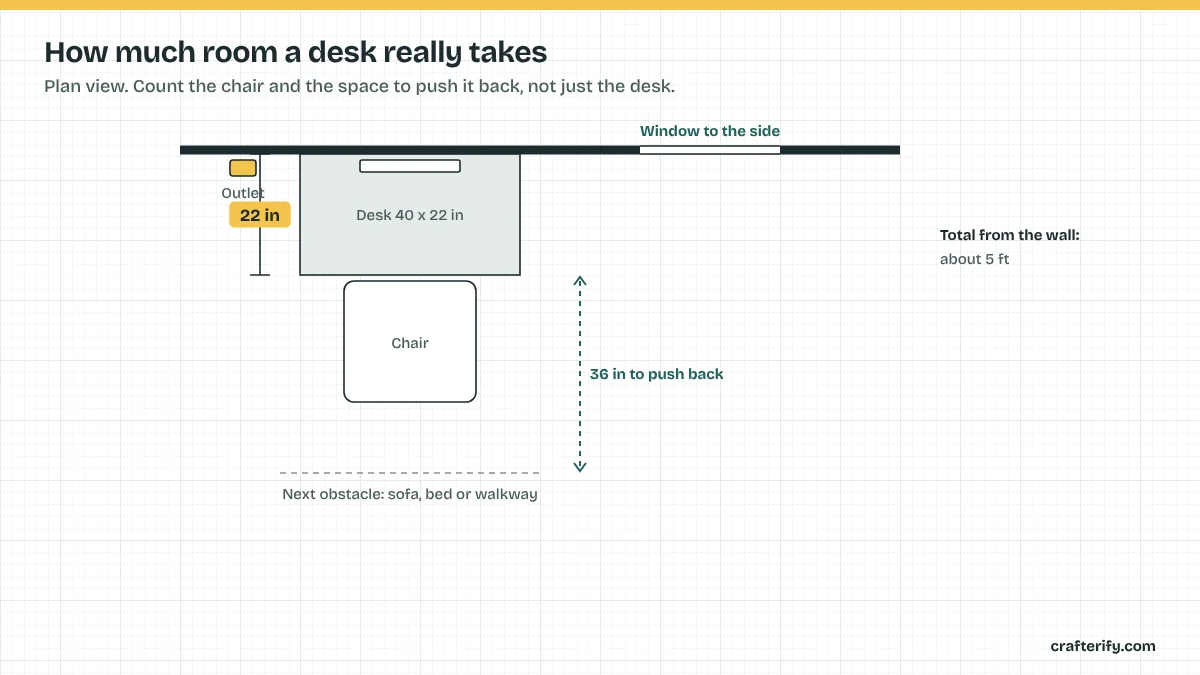
Most people measure the desk and forget the chair. In practice, the space you need is:
- The desk depth: 20 to 24 inches for a laptop, 24 to 30 inches with a monitor.
- The chair: about 20 to 26 inches deep.
- Room to push back and stand up: about 36 inches from the edge of the desk to the next obstacle is comfortable. You can get by with around 30 if the chair doesn’t roll far.
So a desk that’s 24 inches deep takes about 5 feet from the wall into the room when you count the chair. That’s the number to plan around.
Desk sizes for small spaces
| Desk | Width | Depth | Works for |
|---|---|---|---|
| Compact writing desk | 30 to 40 in | 18 to 20 in | Laptop only |
| Standard small desk | 40 to 48 in | 20 to 24 in | Laptop plus notebook |
| Monitor desk | 48 to 55 in | 24 to 30 in | One monitor, keyboard, laptop |
| Corner or L-shaped | Varies | 20 to 24 in each side | Two screens, more surface |
Standard desk height is about 28 to 30 inches. If you’re shorter or taller than average, a desk with adjustable legs is worth it, or adjust the chair and add a footrest.
Good places for a desk
Beside a window. Light from the side is easier on the eyes and doesn’t create glare. Avoid sitting with a window directly behind your screen, which makes the screen look dark, or directly behind you, which puts glare on it.
At the end of the sofa. In a living room, a narrow desk can sit at the end of the sofa or behind it, if the sofa floats in the room. It can double as a sofa table.
In a corner. Corners are often dead space. A small corner desk tucks in without blocking a walkway.
In a closet. If you have a closet you can spare, take the doors off (store them carefully and ask your landlord first) or leave them open, and fit a desk inside. A reach-in closet that’s 24 inches deep fits a compact desk well. This is sometimes called a “cloffice.”
In the bedroom. It works, but if you can, put the desk where you can’t see it from the bed. It helps to separate work from rest.
Things to check before you commit
- An outlet within reach. Running an extension cord across a walkway is a trip hazard. If you need one, use a power strip with a surge protector and route the cord along the wall.
- Wi-Fi strength. Check your connection in the spot before moving everything there.
- The chair path. Make sure the chair doesn’t roll into a door swing or the path to the bathroom.
- Video calls. If you’re on camera, look at what’s behind you. A plain wall or a bookcase works better than an unmade bed.
Desks that fold away
If there’s no permanent spot:
- A folding desk sets up in seconds and slides behind a door.
- A drop-leaf table works as a dining table and a desk.
- A wall-mounted fold-down desk needs screws, so ask your landlord.
- A laptop cart with wheels can roll next to the sofa or bed.
Set it up comfortably
A few basics make a small desk easier to work at: the top of the screen at or slightly below eye level, the screen about an arm’s length away, and your feet flat on the floor. A laptop stand with a separate keyboard and mouse helps a lot if you work on a laptop all day.
Common mistakes
- Measuring only the desk. Remember the chair and the room to push it back.
- Facing a bright window. It strains your eyes and makes you look dark on video calls.
- Cords across walkways. They’re a trip hazard and can pull a laptop off the desk.
- A desk that’s too shallow for a monitor. Under about 24 inches, the screen ends up too close.
A sample setup in a 4-foot corner
| Item | Size |
|---|---|
| Desk | 40 x 22 in |
| Chair | 24 x 24 in |
| Clear floor behind the chair | 36 in |
| Floor lamp or desk lamp | Beside the desk, on the side away from your writing hand |
| Power strip | On the floor against the wall, under the desk |
That fits in about 4 feet of wall and 5 feet of floor, including the chair space.
FAQ
How much space do you need behind a desk chair?
About 36 inches is comfortable. Around 30 inches is the practical minimum.
What size desk fits in a small apartment?
A compact desk 30 to 40 inches wide and 18 to 24 inches deep fits most small spaces and holds a laptop.
Is it bad to put a desk in front of a window?
Facing a window can cause glare and eye strain from the bright background. Side lighting is usually better.