Quick answer
Split the rod and the shelf by measurement, not by guesswork, and give each person their own side so things don’t drift. Move off-season clothes and rarely worn pieces out of the closet entirely. Then add space with matching slim hangers, a hanging shelf organizer for each person, and over-the-door hooks.
In this guide
A small closet is tight for one person. Two people sharing one usually means one side slowly takes over, and someone ends up living out of a laundry basket.
The fix isn’t really about organizing products. It’s about deciding who gets what, and then making the space go further.
Start by taking everything out
It sounds like extra work, but it’s the only way to see what’s there. Each person sorts their own clothes into three groups:
- Wear now: clothes for the current season that you actually wear.
- Wear later: off-season clothes and things for occasions, like formal wear.
- Let go: things that don’t fit or haven’t been worn in a year.
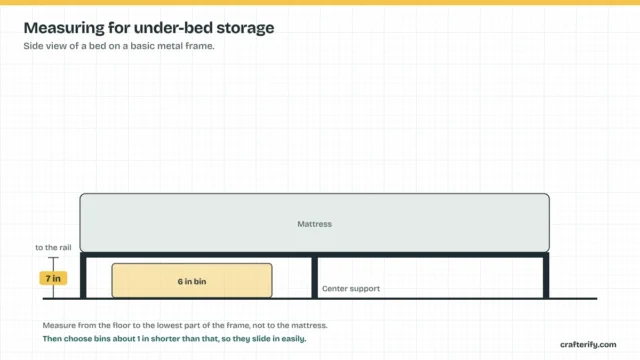
Only the first group goes back in the closet. The second group moves to under-bed bins, a high shelf or vacuum bags. The third group gets donated.
This step alone often frees up a third of the closet.
Divide by measurement
Measure the rod length and the shelf length. Then divide based on how much each person really hangs, not just down the middle.
A simple way to check: line up each person’s “wear now” hanging clothes, pressed together the way they’ll hang, and measure how many inches each takes. If one person has 30 inches of hanging clothes and the other has 18, a 50/50 split leaves one side empty and the other crammed.
Whoever has more hanging clothes gets more rod. The other person gets more of the shelf, the floor or the drawer space somewhere else. It’s fairer than it sounds.
Give each person a clear side
Mixing clothes in the middle is where most closet arguments start. Keep a clear boundary:
- A closet rod divider (a small marker that clips on the rod) shows where one side ends.
- Different hanger colors for each person make it obvious at a glance.
- Separate bins on the shelf, labeled with names or initials.
Put whoever gets dressed first in the morning on the side closest to the door or the light.
Make the closet hold more
Once the split is set, these add-ons help both of you:
| Add-on | What it adds | Needs drilling? |
|---|---|---|
| Matching slim hangers | More items per foot of rod | No |
| Hanging shelf organizer | Shelves for folded clothes from the rod | No |
| Shelf dividers | Neat stacks on the top shelf | No |
| Over-the-door hooks | Spots for bags, robes and tomorrow’s outfit | No |
| Two-tier shoe rack | Shoes off the floor | No |
| Second rod (double hang) | Doubles space for shirts if the ceiling is high enough | Tension rod, no; mounted rod, yes |
Switching both people’s hangers to the same thin style can add several inches of rod space. Bulky plastic and wooden hangers take up more room than you’d think.
A hanging shelf organizer for each person gives you somewhere for folded T-shirts and sweaters without taking dresser space.
Move things that don’t need the closet
Some things live in closets out of habit:
- Shoes can go on a rack by the door or under the bed.
- Bags and backpacks can hang on hooks.
- Workout clothes can live in a drawer or a bin.
- Towels and bedding belong in a linen closet or under the bed if you have one.
Every item that moves out gives room to the clothes that need hanging.
Keep it working
A shared closet stays fair if you reset it now and then. A good time is when the seasons change: swap the off-season clothes in and out, and check whether the split still makes sense.
One easy habit: one in, one out. When either of you buys something new, something old leaves.
Common mistakes when sharing a closet
- Splitting 50/50 without measuring. It feels fair, but it rarely matches how much each person actually hangs.
- Keeping everything in the closet. Shoes, bags, workout clothes and off-season items usually have better homes elsewhere.
- Buying organizers before decluttering. You end up organizing clothes you don’t wear.
- Mixed hangers. Bulky and thin hangers side by side waste rod space and make the closet look messy.
A sample setup for a 5-foot reach-in closet
For a typical reach-in closet about 60 inches wide, a shared setup could look like this:
| Zone | Person A | Person B |
|---|---|---|
| Rod space | 34 in | 26 in |
| Hanging shelf organizer | One, 12 in wide | One, 12 in wide |
| Top shelf | Two labeled bins | Two labeled bins |
| Floor | Shared two-tier shoe rack | Shared two-tier shoe rack |
| Back of the door | Two hooks | Two hooks |
Person B gets less rod space here because they fold more and use more drawer space in a dresser. Adjust the split to fit your own clothes.
FAQ
How do you split a closet fairly?
Measure how much hanging space each person’s current clothes take and divide the rod by that, not 50/50. Balance it out with shelf space, drawers or under-bed storage.
How much closet space does one person need?
For everyday hanging clothes, about 3 to 4 feet of rod is common. People with lots of dresses, suits or coats need more.
What’s the fastest way to make room in a shared closet?
Move off-season clothes out and switch both people to matching slim hangers.