Quick answer
Keep the aisle clear first: nothing on the floor, no cart that blocks the oven or dishwasher door. Then store things where you use them. Pots and pans by the stove, dishes by the sink or dishwasher, food near the fridge. Use cabinet doors, shelf risers and the gap beside the fridge for extra storage, and keep the counters for work.
In this guide
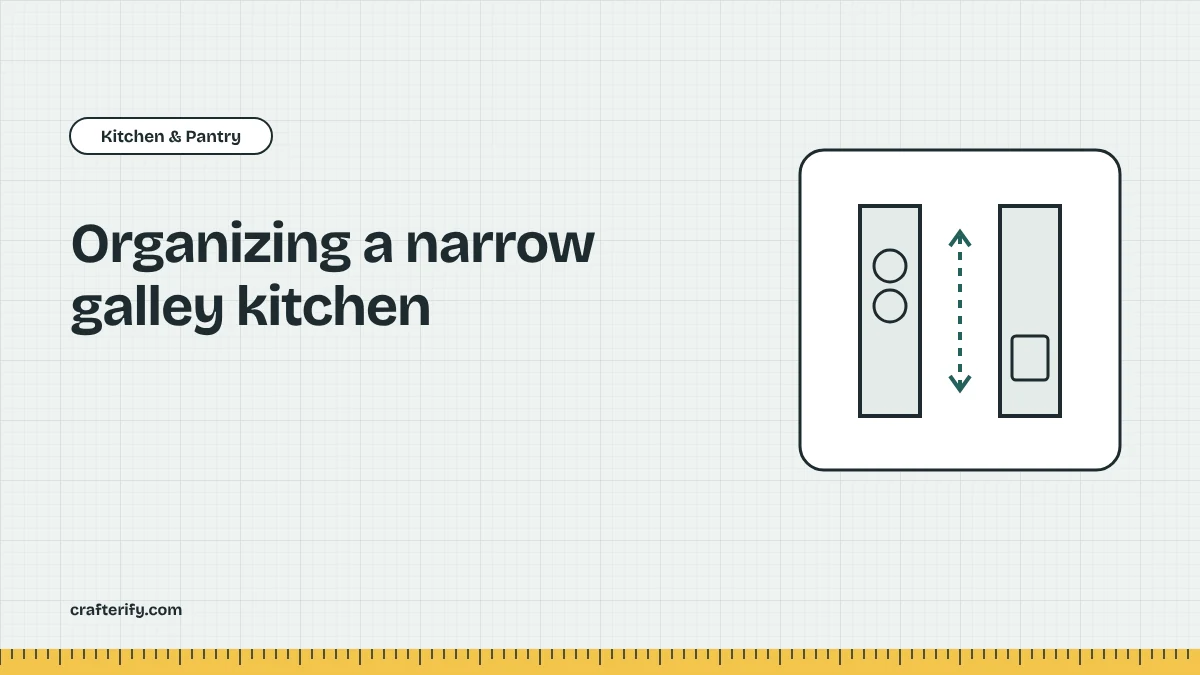
A galley kitchen is two counters facing each other with a walkway in between, or a single counter along one wall. Apartments use them because they fit in a small footprint. The tradeoff is that the aisle can get tight fast, and anything left in it gets in the way.
The goal in a galley kitchen is simple: keep the walkway clear and keep things close to where they’re used.
Measure the aisle
The aisle width tells you what you can add. Measure from the front of one counter to the front of the other, or from the counter to the opposite wall.
| Aisle width | What it means |
|---|---|
| Under 36 in | Very tight. Keep the floor completely clear |
| 36 to 42 in | Workable for one cook. No carts in the aisle |
| 42 to 48 in | Comfortable. A slim cart at one end may fit |
| Over 48 in | Room for two people and a narrow cart |
Also open the oven, dishwasher and fridge doors and check how far they reach into the aisle. Anything you add has to stay clear of those door swings.
Store things where you use them
In a long, narrow kitchen, walking back and forth for every pot adds up. Set up zones based on the appliances:
- By the stove: pots, pans, lids, cooking utensils, oils, salt and spices.
- By the sink or dishwasher: dishes, glasses, flatware, dish soap, towels.
- By the fridge: food storage containers, foil, wrap, snacks.
- At the far end: the things you use least, like roasting pans and holiday dishes.
If your kitchen has one counter between the sink and stove, that’s your main prep spot. Keep it as clear as you can and store the knives and cutting boards right there.
Make the cabinets hold more
Galley kitchens often have plenty of cabinets but they’re not set up well. A few changes help:
- Shelf risers double the useful space on tall shelves for plates and mugs.
- Pan organizers stand pans and lids on their sides so you can grab one without lifting the rest.
- Lid racks inside a cabinet door keep lids from sliding around.
- Drawer dividers stop utensils from becoming one big pile.
Before adding anything to a cabinet door, close it slowly with the rack in place to make sure it clears the shelves inside.
Use the end walls
The short walls at the ends of a galley kitchen are often empty. They’re a good spot for:
- A slim freestanding shelf, 10 to 12 inches deep, for cookbooks or pantry items.
- A narrow rolling cart if the aisle is at least 42 inches and the cart doesn’t block a door.
- A towel or apron hook using a removable adhesive hook, if the item is light.
If the end of the kitchen opens into another room, a slim console or bar cart on the other side can hold overflow like small appliances.
Keep the aisle clear
This is the one rule that matters most in a galley kitchen. Things that tend to creep into the aisle:
- Trash and recycling bins. A pull-out bin under the sink or a slim bin that fits beside the fridge works better than a big can on the floor.
- Rugs that bunch up. Use a low, flat runner with a non-slip pad, or skip it.
- Shopping bags. Unpack right away, or keep one hook just inside the kitchen for them.
Lighting a long, narrow kitchen
Galley kitchens are often lit by a single ceiling fixture, which leaves the counters in your own shadow. Battery-powered or plug-in under-cabinet lights fix that without wiring. Many attach with adhesive or magnets and run on rechargeable batteries. Choose a warm or neutral white so food looks natural.
One cook at a time
In a narrow galley, two people cooking at once means constant shuffling. If you share the kitchen, decide on a simple rule like one person cooks and the other cleans. It’s not an organizing trick, but it avoids a lot of bumping into each other.
Put it together
- Measure the aisle and the door swings.
- Move things so each zone holds what’s used there.
- Add risers and pan organizers to the cabinets.
- Use the end walls for shelves or a slim cart.
- Clear the floor and fix the lighting.
Common mistakes
- A cart in a narrow aisle. It blocks doors and turns cooking into an obstacle course.
- Storing heavy pots up high. In a galley, the upper cabinets are often within reach, but heavy cast iron belongs low.
- Overloaded cabinet doors. Racks on doors can stop them from closing and stress the hinges.
- A big trash can on the floor. It’s the most common thing in the walkway.
FAQ
How wide should a galley kitchen aisle be?
About 42 inches is comfortable for one cook. Many apartment galleys are narrower, around 36 inches, which still works if nothing sits on the floor.
Can you put a cart in a galley kitchen?
Only if the aisle is wide enough, about 42 inches or more, and the cart doesn’t block the oven, dishwasher or fridge doors. Otherwise put it at the end of the kitchen or just outside.
How do you make a galley kitchen feel bigger?
Clear the counters, add under-cabinet lights, and keep the floor empty. A light, flat runner and fewer things on the walls also help.