Quick answer
Keep the fridge at 40°F or below. Put ready-to-eat food and leftovers on the upper shelves, raw meat in a container on the bottom shelf, produce in the drawers, and condiments in the door. Use a few clear bins to group small items, and do a quick clean-out once a week before you shop.
In this guide
Many apartments come with a smaller fridge than you’d find in a house. A 24-inch-wide model is common, and it often holds around half as much as a full-size fridge. That makes every shelf count.
The good news is that a small fridge is easier to keep organized once each shelf has a job.
Set the temperature first
Before rearranging anything, check the temperature. The USDA recommends keeping the fridge at 40°F or below and the freezer at 0°F. Many fridge dials don’t show degrees, so an inexpensive fridge thermometer is worth having. Small fridges packed full can run warmer than you’d expect.
Give each shelf a job
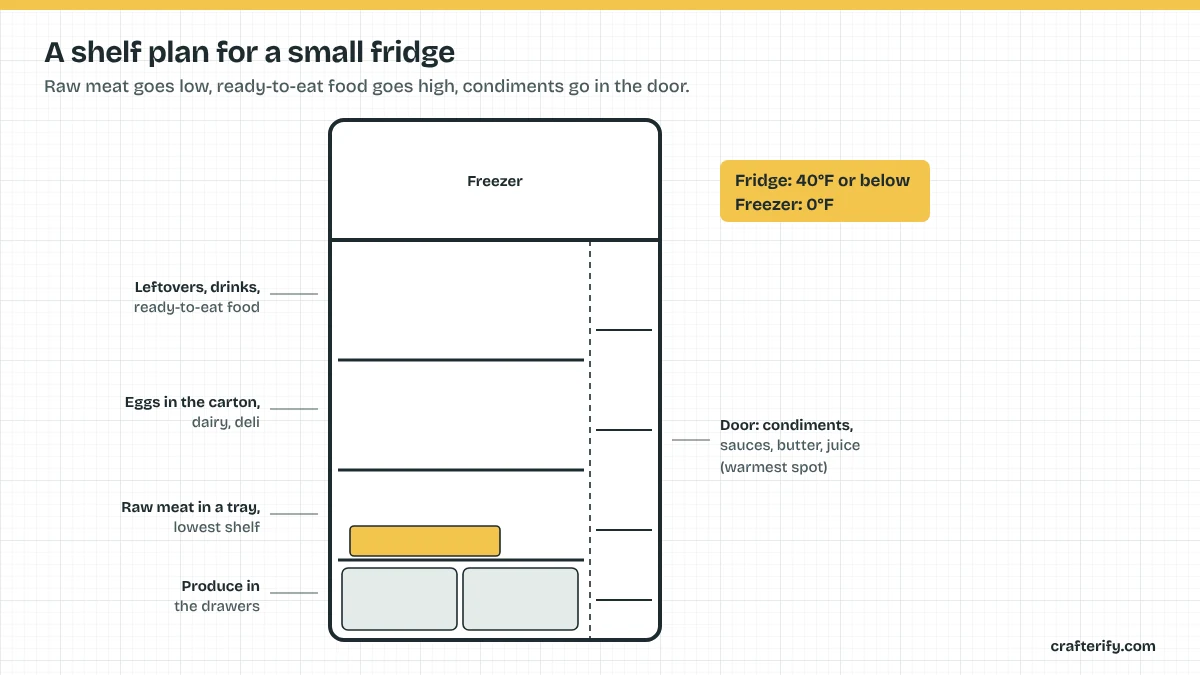
A simple layout that follows food safety advice and makes things easy to find:
| Spot | What goes there | Why |
|---|---|---|
| Top shelf | Leftovers, drinks, ready-to-eat food | Easy to see, and nothing raw drips onto it |
| Middle shelf | Eggs, dairy, deli items | Steady temperature in the main compartment |
| Bottom shelf | Raw meat, poultry and fish in a tray or container | Lowest spot, so juices can’t drip onto other food |
| Crisper drawers | Fruit in one, vegetables in the other | The drawers hold humidity |
| Door | Condiments, sauces, butter, juice | The door is the warmest part of the fridge |
Keep eggs in their carton on a shelf rather than in the door. The carton protects them and the shelf stays colder than the door does.
Use bins for small things
In a narrow fridge, the problem usually isn’t space but small items getting pushed to the back. A few clear bins fix that:
- A snack or lunch bin that you can pull out in one move.
- A “use this first” bin at eye level for leftovers and open containers.
- A tray for raw meat on the bottom shelf to catch any leaks.
Measure your shelf depth before buying. Apartment fridges are often around 12 to 15 inches deep inside on the shelves, so bins made for full-size fridges can be too long. Two shorter bins usually work better than one long one.
Get more from the height
Many small fridges have shelves set farther apart than you need. A few ways to use the extra height:
- Adjust the shelves if your model allows it. Set them to fit what you buy, like a lower gap over the drawers and a taller one for bottles.
- Stackable containers for leftovers let you build up instead of out. Choose ones with flat lids.
- A can or bottle rack lays drinks on their side, often fitting more than standing them up.
Don’t pack shelves so tight that air can’t move. Fridges cool by circulating air, and blocking the vents at the back can leave parts of the fridge too warm.
The freezer in a small fridge
Small top-freezers fill up fast. Freeze things flat in bags, then stand the bags up like files once they’re frozen. Label each bag with the date. Most frozen food stays safe indefinitely at 0°F, but the quality drops over time, so use older items first.
A five-minute weekly reset
The habit that keeps a small fridge working is a short clean-out before you shop:
- Take out anything spoiled or past its date.
- Move older leftovers to the front or into the “use this first” bin.
- Wipe any spills, especially on the bottom shelf.
- Make your shopping list based on what’s actually there.
Leftovers are generally best eaten within 3 to 4 days, according to USDA guidance. Writing the date on the lid with a marker or a piece of tape makes this easy to track.
What doesn’t need to be in the fridge
Freeing up space sometimes means taking things out. Whole tomatoes, bananas, potatoes, onions and bread often do fine at room temperature, depending on how fast you use them. Check the label on sauces and spreads; some say “refrigerate after opening” and some don’t.
Common mistakes
- Overpacking. A crammed fridge cools unevenly, and food in the back gets forgotten.
- Milk in the door. It’s the warmest spot, and milk keeps better on a shelf.
- Raw meat on a high shelf. Juices can drip onto ready-to-eat food below.
- Hot food straight into a packed fridge. Let leftovers cool briefly, then refrigerate within two hours, as USDA guidance advises, in shallow containers so they chill quickly.
FAQ
What temperature should a fridge be?
40°F or below for the fridge and 0°F for the freezer, based on USDA guidance. A fridge thermometer is the easiest way to check.
Where should raw meat go in the fridge?
On the bottom shelf, in a container or tray, so nothing can drip onto food that won’t be cooked.
Should eggs go in the fridge door?
It’s better to keep them in their carton on a shelf. The door warms up every time it opens.
How do you fit more in a small fridge?
Give each shelf a job, use short clear bins for small items, adjust shelf heights to what you buy, and take out things that don’t need refrigeration.